Crypto To Crush Overnight Lending Market + FED Backstop Bailout

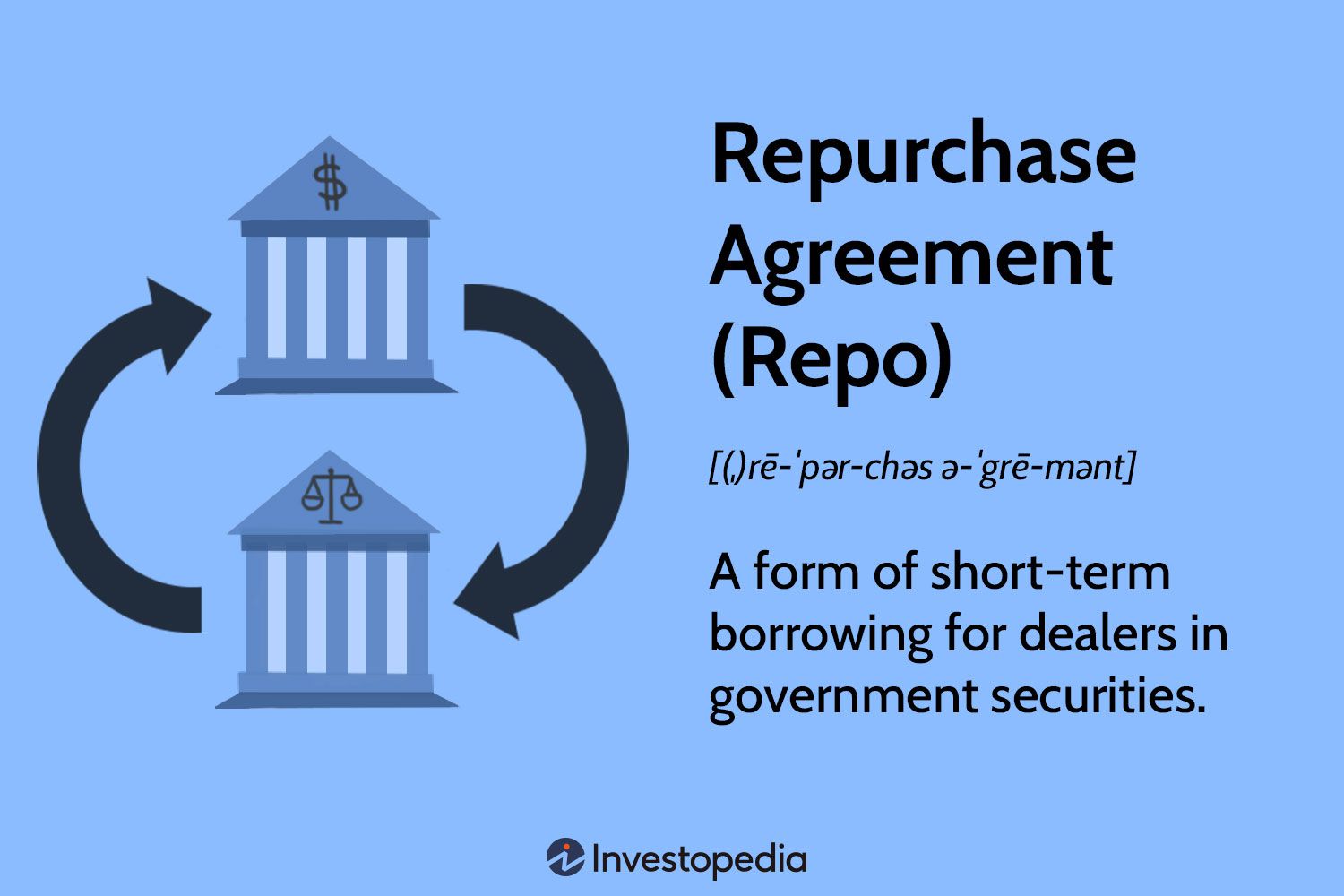
Repo Market (Repurchase not Repossess)
I don't know about you, but when I heard the word "repo" I always think of "repossession". As in your car was repossessed, or perhaps even your organs!
After all "Repurchase" doesn't have an 'o' in it.
Neither does "agreement".
Go figure.
The repo market enables market participants to provide collateralized loans to one another, and financial institutions predominantly use repos to manage short-term fluctuations in cash holdings, rather than general balance sheet funding.
This is something @taskmaster4450 has discussed many times, but I never quite had a grasp on it before. I'm beginning to understand this market with a little bit more clarity now though. We all use the Repo market without even realizing it.
For example, remember back in the day when you'd make a deposit on Coinbase and you'd have to wait an agonizing 5 business days before the money was ready to trade? By that time perhaps the dip you wanted to buy doesn't even exist anymore. Such is crypto.
Coinbase fixed this problem and removed the delay by extending users a temporary line of credit to their users. I can deposit $500 right now and have access to $500 right now. I can even buy crypto with it. What I can't do is withdraw it from the platform until the bank clears my transaction (1-5 business days).
Should the bank transaction not be cleared Coinbase will repossess my collateral, be it $500 cash or Bitcoin. If the crypto they collect is worth less than $500 they'll probably even send me a bill or garnish some money from my account if it exists.
Now I have no idea how this temporary line of credit is extended on Coinbase's backend. I have no idea if they borrow money from a bank to make it happen. Probably not, right? Why would they? They can just front the money themselves. It doesn't really matter how it is accomplished logistically because the frontend result is the exact same outcome as the repo market. An invisible temporary line of credit is extended to remove the delay from the lumbering banking sector.
But what if there was no delay?
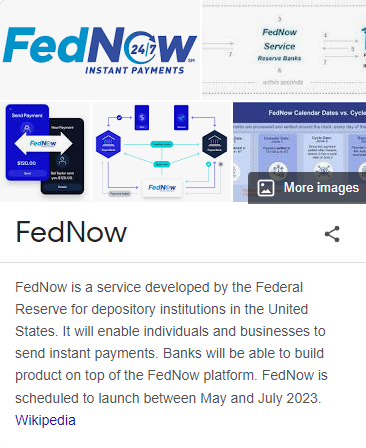
What if transactions within the banking sector cleared instantly? Then this whole concept of a Repo market would become completely antiquated and would have no reason to exist. Not only can crypto accomplish this feat, but the new FedNow project can as well. I'm hearing reports that FedNow will be launched in the summer which should make payments near-instant, again potentially eliminating the need for overnight lending in certain areas.
Given this development do we really still think that CBDC is something we have to worry about right now? CBDC would completely undermine FedNow. Why would anyone allow CBDC to happen? The bankers don't want it. What is the point of retail banking if the government can just print money as they see fit? It makes no sense... the ability to print money is retained and protected by retail banking. They aren't going to roll over and die while the government tries to push CBDC.
Although the CBDC narrative is ramping up pretty fast and we should continue paying attention to it. But being alarmist about it is totally pointless. Just wait and see what happens. It's not something that can be prepared for anyway. This is a reactive situation, not preemptive/proactive one.
This video is pretty informative about the current bailout situation with the banks and the backstops that are being put in place. I'm listening to it as I write this and I'll give the rundown below.
You can put perfume on a pig but it still smells like a pig.
In other words, the government can pretend it's not a bailout but it is.
At 4:30
Security collateral is not marked-to-market.
This is a revelation that I had no idea was going on. Banks can borrow money from the backstop using securities whose value has tanked. Imagine the bank bought Tesla stock at $8000 a share and the price tanks to $1000 a share. Let's say they bought a million shares currently worth a billion dollars. They can put those securities up as collateral and borrow from the backstop as if it is still worth the $8B they originally bought it for! Mindblowing! Holy shit. Yeah... that's going to end well. lol
At 6:00
Silicon Valley Bank did not have an insolvency problem; they had a liquidity problem.
SVB bought a bunch of securities largely with money given to them from startup companies. Apparently they offered a higher rate of return than other banks which is why these startups were so motivated to deposit there in the first place. SVB bought these securities that paid a higher interest rate than what they promised the depositors. Classic banking 101 stuff.
However, the securities they purchased (mortgage-backed securities and bonds I believe) were "sensitive to interest rates" so when the FED jacked up the fund rate SVB did not pivot correctly. The value of their securities went down and they were forced to sell at a loss to cover the bank run.
This isn't particularly revolutionary news as I kind of explained this in previous posts... but I'm just summarizing the above video and it's good to have a robust outlook.
They had a liquidity problem that could have been fixed.
It wasn't broke.
At 7:50 to end
President Biden's bailout could have been avoided if we had done any one of these three things:
- Management of SVB should have hedged against their risk.
It's banking 101, SVB bankers were incompetent.- Regulators didn't catch it.
The regulators were also incompetent.
The private sector even reported on this risk in advance.- The bank should have been bought out by another entity.
This is the normal response to this situation.
But FDIC doesn't like bank mergers.
Even though a merge was ideal: politics got in the way.
FDIC stalled the situation and panic ensued.
Interesting take.
So was this all just a mistake and complete incompetence, or did everyone just want an excuse to put this backstop into play where securities can be collateralized at the price of purchase? It's quite unclear, but we definitely should keep that in mind going forward. A situation like this almost certainly will not end well. This backstop is a farce and potentially a way for banks to once again borrow more money than they'll ever be able to pay back.
It's also important to note what a "security" is within this context. The example I gave was Tesla stock, but I think something like this really applies more to the bond market and safer derivatives, as those are usually the kind of 'low-risk' assets that banks are normally willing to take on. Even lower risk now that they can borrow against their own busted trades without a penalty, amirite? lol. What a wild situation. I won't even pretend to fully understand this development and the Butterfly-Effect that will emerge from it. Nobody does.
Conclusion
Overnight lending is something we use all the time without even knowing it. It happens in the background. Have you ever transferred money from Venmo to your bank account and instantly gotten access to the funds? That's not because the transaction happened fast; it's because Venmo extended you a line of credit based on the collateral within your account or the account of the person that sent you money. Venmo doesn't get the money until the bank transfer actually clears. It's important to keep this in mind going forward.
FedNow and crypto could completely eliminate the need for the repo market given enough infrastructure and fast transactions that settle near-instantly. Just look at Hive. Used to be transactions would settle in around a minute and now it's more like 4.5 seconds max. Pretty impressive if you ask me. How will these developments affect the legacy economy as we continue to build? I have no idea. Nobody does, but we'll eventually find out as it becomes implemented within the field of finance.
The FEDs bailout via a liquidity backstop is super interesting and definitely something we need to be paying attention to. I'd love to call it an 'innovative solution' to the problem of short-term liquidity as it pertains to securities that have lost their value... but we all know this is just more bailout fuckery as the decline of an empire continues.
The FED created this situation by raising rates within a clearly DEFLATIONARY environment. The numbers show that there is a dollar shortage worldwide. The FED made it worse by increasing rates. Nobody cares. The price of goods and services went up and everyone wrongfully called that "inflation".
You reap what you sow. Now the FED has to bend over backwards and provide a backstop to the banks they fucked over. This will not end well for them, but they may be able to kick the can down the road one more time until the next recession like they always do. Until then guess who gets to pay for their mistakes?
Posted Using LeoFinance Beta
I actually really like Repo! The Genetic Opera :)
This post has been manually curated by @bhattg from Indiaunited community. Join us on our Discord Server.
Do you know that you can earn a passive income by delegating your Leo power to @india-leo account? We share 100 % of the curation rewards with the delegators.
100% of the rewards from this comment goes to the curator for their manual curation efforts. Please encourage the curator @bhattg by upvoting this comment and support the community by voting the posts made by @indiaunited.
And every time they manage to kick the can further down the road the actual problem gets bigger…
Our generation has to deal with so much more uncertainty than our parents!
The Australian Federal Reserve actually has something like this. I can send money from my Aussie bank to another Aussie bank and they receive the money instantly. It's honestly incredible. The Australian Federal Reserve basically provides the liquidity to the receiving bank until it's all confirmed - dramatically reducing cash flow issues between businesses.
There is another narrative that better explains these banking runs from the perspective of the WEF cutting supply lines. The specific banks were chosen in order to discourage crypto, but that certainly hasn't been the result of the bank closures, has it?
Yet.
On Wednesday SVB was fine, in fact operating quite conservatively with ~30% more reserves than most banks. On Thursday Peter Thiel started telling his clients to withdraw their money from SVB, creating a run on the bank. On Friday the regulatory authority seized it.
He had help.
Former US Senator Barney Frank is today stating Signature Bank was unnecessarily seized by regulators similarly.
Seems to me that no fractional reserve bank is immune to a bank run. Lending out customer deposits creates the endemic risk of too many depositors taking out their money at one time. Every fractional reserve bank in the world has this inherent feature/bug.
Credit Suisse is where many WEF members keep their funds, so when it almost collapsed they shored it up, which could have been done to both SVB and Signature Bank. Per our benevolent AI overlords:
This suggests to me that this is a deliberate political decision to close banks that are 'crypto friendly', disabling centralized exchanges that depend on them to enable customers to exchange fiat for crypto, or to maintain their fiat balances necessary for the exchanges to exchange fiat for crypto, from doing business.
I have to point out that this is EXACTLY why I do not use crypto as money, nor banks, because I have been 'bailed in' before and have learned to 'bank' other assets than fiat or money that can only be exchanged for fiat through KYC exchanges. There is fine print boiler plate in many service contracts to the effect of 'failure to enforce a provision does not forfeit the right to do so at any time in the future.' That seems to be what is going on now, using the vulnerability of centralized exchanges to legacy financial systems to cut the route to exchange fiat for crypto.
Whether that can, or will succeed, or is even the case, remains to be seen, and events will establish the actual reasons for these political decisions to crash these banks. However, nothing about these banks was mismanaged relative to other banks, and they appear to have been deliberately scuttled, with some parties working at the bank aware of what was going to happen weeks before it happened, as revealed by their selling off their stock in SVB during that time.
That genetic repo video seemed pretty cool until it turned into a musical, or appeared to be about to.
Thanks!
Repo is a musical I never watched for the same reason, but I remember it well.
It was quite popular back in the day.
Them Californians loved it, along with the Rent musical.
I don't get it.
I don't think it is possible to cut crypto off from the banking sector.
All those moves will clearly be futile and temporary, as crypto users are more than willing to pay a premium to make it worthwhile to do business. Also I hear Kraken has had enough of the banking BS and is creating their own bank, which is a whole other thing. To be honest I hope this "attack" continues, as crypto has proven itself to be quite resourceful. Once the onramps are decentralized it's all over. In fact the onramps are not even necessary given more infrastructure and adoption... so infrastructure and adoption will be accelerated if the attack continues.
What would make more sense if the entire strategy was temporary in nature.
USG wants to crash crypto in the short term. Why? Are the cronies buying? Perhaps they just want to choke the industry as much as possible so there is less resistance against regulatory overreach. To me this is what makes the most sense considering how the SEC is acting. Others take it one step further and claim this is to pave the way for CBDCs. Personally I don't think that CBDCs can hurt real crypto in any way, and will actually empower crypto by making swaps to fiat even easier. It's unclear what's going on but I think we'll figure it out within a year or two.
And once there's a form of money without counterparty risk, I'll be all over it. I have no interest in making myself vulnerable - again - to the swindling vampires that stole my house more than a decade ago. When there's a form of money that is secure from just being taken at their whim, which no crypto is today, since it all can only be accessed through centralized exchanges vulnerable to the KYC and legacy financial system, I'll use it.
I got fooled once. Cost me everything I owned and worked for all my life. Not going to do that again.
As you see, banks are equity traps they can spring whenever they want. Therefore I invest in goodwill they can't touch.
Are you comfortable enough holding value as Hive or Bitcoin directly on chain?
Or are the systemic threats to the chains also too much risk?
I am comfortable enough to hold the Hive I have accumulated on Hive. Because I cannot secure such asset from externalities, I am unwilling to do more. As I have said, I invest in reciprocal markets with individual people in my community, and primarily in goodwill that can be depended on to not be taxed, censored, or stolen by outside actors.
I have zero trust in banks (actually, I have negative trust for banks. I am confident every bank is owned by thieves), or any mechanisms that involve banks in any way, and have no route to crypto, in or out, that isn't subject to banks. Having once been swindled without any recourse I will not again be vulnerable. I have learned that money is not wealth. Independent means is wealth, and I can't secure money from banks. It's just not possible per my understanding of extant mechanisms.
In the event state actors sever BTC from legacy financial systems - banks - any investment in BTC would simply disappear, because we cannot ride to town on ponie and trade BTC with paper wallets. BTC and all cryptos depend on the internet, and increasing censorship reveals the internet is a trap. The present attacks on crypto friendly banks further dissuade me from considering crypto a safe investment.
I see no way to secure crypto without permissionless communications that cannot be censored, and oligarchs own all the ISPs and infrastructure of the internet. When they decide they don't want us to transact in crypto on the internet, they will prevent such transactions with facility. Therefore such investments are completely subject to the tolerance of the owners of the internet infrastructure, and they have already stolen everything I owned once.
Once is enough.
Edit: Immediately after I posted this reply, I read Simon Black's post on Sovereign Man, which exemplifies my understanding regarding banks - except he inexplicably characterizes them as incompetent rather than malevolent, which I call inexplicable because there is so much evidence of malevolence in the writing of the Chairman of the WEF, Klaus Schwab, the policies of the Chairman of BlackRock, and the Agenda Director of the WEF, Larry Fink, and the very simple fact that government agents are chosen by those that manage $T's who are very obviously extremely competent at that task, because literally billions of people, many of whom are geniuses, are competing with them for control and possession of those financial assets. I posted evidence of deliberate malfeasance in the recent shuttering of banks, and of that being undertaken as part of an attack on crypto.
Proof isn't going to be available. Evidence is all there is to go on. I therefore will not be dependent on financial assets, because there is clearly ongoing malfeasance in financial networks that I cannot be secure from on those networks. That is why I invest outside those networks, where I can secure all my assets, or die on that hill in the attempt.
Imma die. Might as well go to Valhalla when I do.
They will print more money to bail out the banks and we will pay in inflation indirectly and via our taxes directly
Posted Using LeoFinance Beta
Gotta use those irs agents for something amirite?
Certainly they won't target the rich!
Great analysis and clear explanation of the "bank speak." !BBH
@edicted! Your Content Is Awesome so I just sent 1 $BBH (Bitcoin Backed Hive) to your account on behalf of @fiberfrau. (1/5)