Retro Film Review: Seven Days in May (1964)

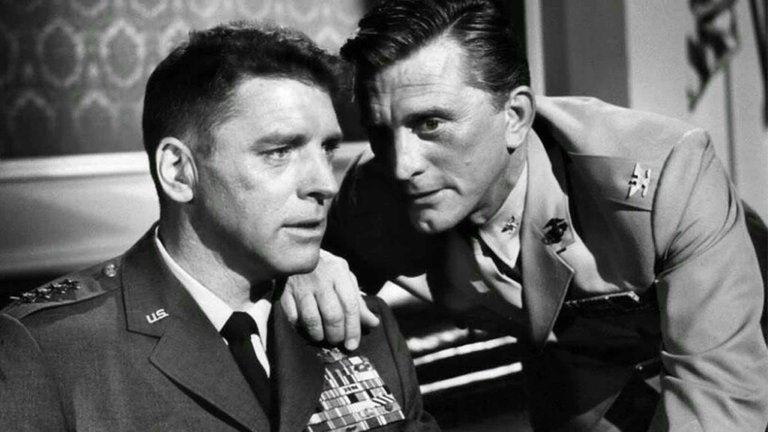
For many people around the world (and in the USA, at least before last year’s unpleasantness) the outcome of the 2000 US presidential election was nothing short of a coup d’état. Various historians and conspiracy theorists may cite other examples of American government resting on something other than the will of the people, but the USA has so far been fortunate enough to avoid the kind of events usually described by the phrase ‘coup d’état’ in most other countries — a group of people in uniforms overthrowing a legitimate government and seizing power. However, that does not mean it cannot happen, and Seven Days in May, a 1964 political thriller directed by John Frankenheimer, explored that disturbing possibility.
The plot of the film, based on the best-selling novel by Fletcher Knebel and Charles W. Bailey II, is set during the Cold War. President Jordan Lyman (played by Fredric March) has signed a nuclear disarmament treaty with the USSR, only to helplessly watch his noble deed turn into political disaster at home — the defence industry in shambles, high unemployment, and multitudes of congressmen and senators screaming bloody murder under pressure from their constituencies. General James Mattoon Scott (played by Burt Lancaster), the charismatic and popular head of the Joint Chiefs of Staff, is passionately opposed to the treaty, viewing it as the ultimate betrayal of national security. As the debate intensifies and Lyman’s poll numbers continue to drop, Scott and the rest of the military establishment are preparing for seemingly routine manoeuvres — but Scott’s aide Marine Colonel James ‘Jiggs’ Casey (played by Kirk Douglas) notices strange details about this particular exercise. Before long, Casey reaches the disturbing conclusion that Scott is preparing a military takeover of the government. He informs the President of his doubts, but Lyman decides not to act against potential conspirators before gathering enough evidence. Instead, he sends his most trusted associates to investigate, though they have only a few days before the exercise begins.
Seven Days in May is the perfect embodiment of the phrase ‘they don’t make them like this anymore’. Made four decades ago, this political thriller differs in many ways from contemporary examples of the genre. It does not feature a single shootout or car chase, relying entirely on drama as its source of tension. Instead of a lone hero single-handedly destroying a vast and seemingly all-powerful conspiracy, the film presents a more realistic scenario involving multiple characters who are sometimes as ruthless as the conspirators. Crucially, both sides in the conflict are portrayed as patriots deeply convinced their cause is just, creating painful dilemmas for characters caught between loyalties. As a result, moral alignments and motivations are blurred, and the film relies on excellent performances to portray inner conflicts that prove as nerve-racking as the external struggle. A good example is the character of ‘Jiggs’ — an officer who admires General Scott and shares his stance on nuclear disarmament but stops short of violating the Constitution. Kirk Douglas excels in the role, conveying a wide range of conflicting emotions. Burt Lancaster, one of the acting giants of the era and a frequent co-star of Douglas, is compelling as a general who remains patriotic and brave even while engaged in treachery. Fredric March is also very good as the seemingly weak president forced to find statesmanship in the worst imaginable circumstances, while Edmond O’Brien provides effective comic relief as an alcoholic senator from Georgia.
Being a product of its time may not work entirely in the film’s favour, as modern audiences — especially those who grew up after the Cold War — may struggle to grasp the dilemma that haunted superpower leaders then: whether to keep the peace by building more bombs and risk a freak accident triggering mutually assured destruction, or to disarm and stake the survival of the nation on the other side’s good faith. This dilemma is well presented in the film, with both sides given room to plead their case, and many viewers may feel tempted to side with General Scott when he argues that a mere piece of paper, whether a treaty or the Constitution, is worthless when it comes to safeguarding peace and national security. Such sentiments can still be found today, for instance in the aftermath of the WTC bombing — many people are prepared to sacrifice civil liberties for the sake of security. Unfortunately, when it comes to resolving this dilemma, screenwriter Rod Serling — best known for The Twilight Zone — resorts to an unconvincing combination of deus ex machina and pro-Constitution sermon. This weak ending contrasts sharply with the otherwise realistic setup of the film. Also unconvincing is the subplot involving General Scott’s former mistress, seemingly introduced only to create a role for Ava Gardner in a story where all major characters are men. Finally, Jerry Goldsmith’s soundtrack is disappointing compared to his later triumphs.
Despite being very much of its time, Seven Days in May remains a thoughtful, provocative film that feels more relevant to our own era than we might like to admit.
RATING: 7/10 (+++)
(Note: The text in its original form was posted in Usenet newsgroup rec.arts.movies.reviews on February 1st 2002)
==
Blog in Croatian https://draxblog.com
Blog in English https://draxreview.wordpress.com/
Cent profile https://beta.cent.co/@drax
Minds profile https://www.minds.com/drax_rp_nc
Brave browser: https://brave.com/dra011
BTC donations: 1EWxiMiP6iiG9rger3NuUSd6HByaxQWafG
ETH donations: 0xB305F144323b99e6f8b1d66f5D7DE78B498C32A7
Movie URL: https://www.themoviedb.org/movie/23518-seven-days-in-may?language=en-US
Critic: AA
According to the Bible, Is it sin against God if a law enforcer is forced to take someone's life in the line of duty?
(Sorry for sending this comment. We are not looking for our self profit, our intentions is to preach the words of God in any means possible.)
Comment what you understand of our Youtube Video to receive our full votes. We have 30,000 #SteemPower. It's our little way to Thank you, our beloved friend.
Check our Discord Chat
Join our Official Community: https://beta.steemit.com/trending/hive-182074