Film Review: Looking for Mr. Goodbar (1977)

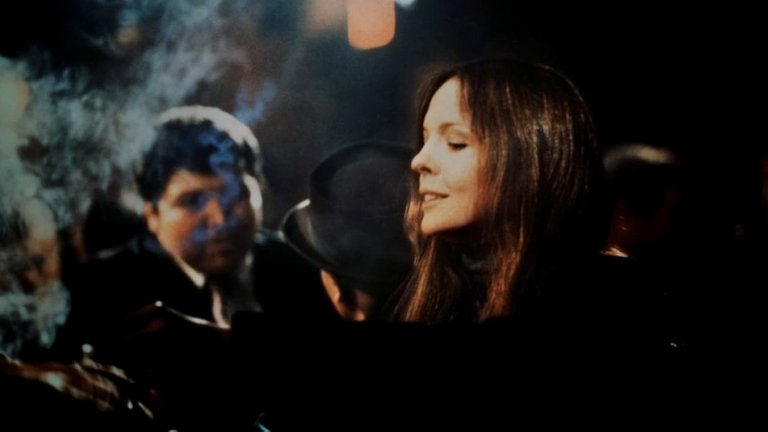
The sexual revolution and other socioeconomic trends allowed Baby Boomers to enjoy sexual freedom and other hedonistic delights unimaginable before in modern history. However, a lifestyle based on unrestrained sex and drugs brought with it new problems and serious risks, which were explored as a plot in Looking for Mr. Goodbar, the 1977 drama directed by Richard Brooks.
The film is based on the best-selling 1975 novel by Judith Rossner, itself inspired by the real-life case of Roseann Quinn, a New York schoolteacher whose brutal murder revealed her double life. The protagonist, played by Diane Keaton, is Therese Dunn, a young woman brought up in a traditional Catholic family. At college, she has an affair with a married professor, Martin (played by Alan Feinstein), who leaves her before graduation. She takes a job as a teacher at a school for deaf children and excels at her work, earning the respect of her pupils and colleagues. However, her private life is less orderly and, after moving from her family home into a new apartment, she begins to spend nights cruising bars in search of casual sex. This leads to a relationship with Tony (played by Richard Gere), a charming but vain Italian-American man who introduces her to cocaine and other party drugs. Her job, on the other hand, introduces her to James (played by William Atherton), a social worker whose traditional morals make him a “safe” and reliable choice as a romantic partner. Therese ultimately finds both alternatives too constraining and instead continues with her increasingly promiscuous lifestyle. That would ultimately lead her to Gary (played by Tom Berenger), a good-looking young man who is actually a bisexual ex-convict with a tendency for sudden outbursts of brutal violence.
If there is a film that Looking for Mr. Goodbar should be compared to, it is Saturday Night Fever. Both films depict nightlife in 1970s urban America, both feature a soundtrack based on disco, and both serve as a sort of time capsule of the lifestyles and social mores characteristic of those times. This comparison might also explain why Fever remains one of the most iconic films of its time, while Goodbar, despite modest success at the box office, quickly sank into obscurity. The main reason is the terribly inept and misguided direction by Richard Brooks, who apparently took the darkness of the original story too literally and tried to match it with a dark cinematography that makes the characters confusing. Bad editing, including “artsy” scenes in which Therese’s reality alternates with her bizarre fantasies, makes the confusion even worse. Finally, there is also a serious issue with pacing that would make this film challenging to watch even for an audience accustomed to plots unfolding slowly.
The only bright spot in this film happens to be Diane Keaton. Obviously excited by the opportunity to display her acting range in a role quite different from those in Woody Allen’s films or The Godfather (which is, semi-ironically, referenced in the film), Keaton delivers a very good performance, which also includes explicit sex and nudity. The rest of the cast is mostly solid, and that includes even a young Richard Gere, whose semi-naked appearance would probably delight a female audience and whose energetic performance would later make him a great star, although initially typecast in roles as a stud. Berenger is also good, despite having the thankless role of a character who is both despicable, pathetic, but ultimately dangerous. Tuesday Weld, on the other hand, sometimes tries too hard in the role of Therese’s older and “liberated” sister, who enthusiastically embraces new sexual freedoms like divorce, abortion, porn films, and swinger parties.
One of the reasons for the relative obscurity of Looking for Mr. Goodbar could also be found in its content having insufficient “political correctness” for later times. Even during its premiere, some critics attacked the film as anti-feminist and reactionary in its values. Some feminists today would, on the other hand, attack this film simply because the protagonist has sexual relations with men, despite all forms of masculinity, as depicted in this film, being toxic. On the other hand, this film also shows how times quickly change. The best example is the scene in which Martin attempts to use condoms while with Therese, only to be mercilessly mocked for relying on such an obsolete and useless tool; this scene became rather outdated in the 1980s with the AIDS pandemic, during which condoms became next to obligatory for sex. It could be argued that a similar change, although in the opposite direction, might happen with bars, at least in the case that the COVID-19 pandemic with its lockdowns and curfews becomes permanent.
RATING: 3/10 (+)
Blog in Croatian https://draxblog.com
Blog in English https://draxreview.wordpress.com/
Leofinance blog https://leofinance.io/@drax.leo
Cent profile https://beta.cent.co/@drax
Minds profile https://www.minds.com/drax_rp_nc
Uptrennd profile https://www.uptrennd.com/user/MTYzNA
Hiveonboard: https://hiveonboard.com?ref=drax
Rising Star game: https://www.risingstargame.com?referrer=drax
1Inch: https://1inch.exchange/#/r/0x83823d8CCB74F828148258BB4457642124b1328e
BTC donations: 1EWxiMiP6iiG9rger3NuUSd6HByaxQWafG
ETH donations: 0xB305F144323b99e6f8b1d66f5D7DE78B498C32A7

Congratulations @drax! You have completed the following achievement on the Hive blockchain and have been rewarded with new badge(s) :
Your next target is to reach 65000 upvotes.
You can view your badges on your board and compare yourself to others in the Ranking
If you no longer want to receive notifications, reply to this comment with the word
STOPCheck out the last post from @hivebuzz:
Support the HiveBuzz project. Vote for our proposal!